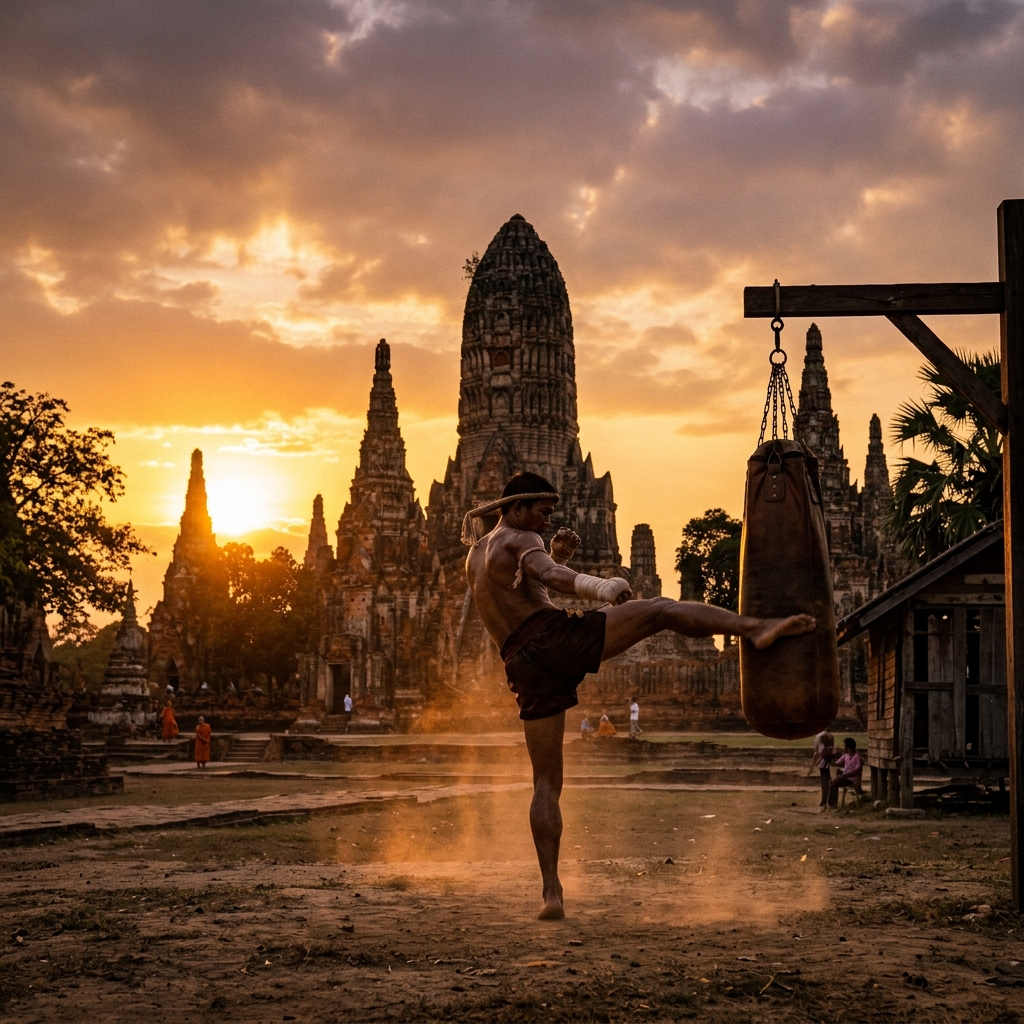
Ancient Martial Arts
Muay Thai History
The legendary martial art fusing the spirit and identity of the Thai nation, from ancient battlefields to a global sport.
The legendary martial art fusing the spirit and identity of the Thai nation, from ancient battlefields to a global sport.
Humans have known the word "struggle" since we first opened our eyes to the world. We must battle everything around us—and even ourselves—without exception. We fight against nature, natural disasters, wild beasts threatening our lives, or hunting animals for food. But at times, humans also fight each other, whether for ownership rights, freedom, self-defense, or other reasons. Such struggles require physical strength, mental fortitude, and strategic intelligence.
Regardless of the purpose, the ultimate goal of combat is survival. Humans have continually strived to invent combat methods to neutralize threats swiftly. When both sides are armed with lethal weapons, direct confrontation becomes highly dangerous, fostering mutual caution. Consequently, humans have sought innovative ways to overcome their opponents easily and rapidly.
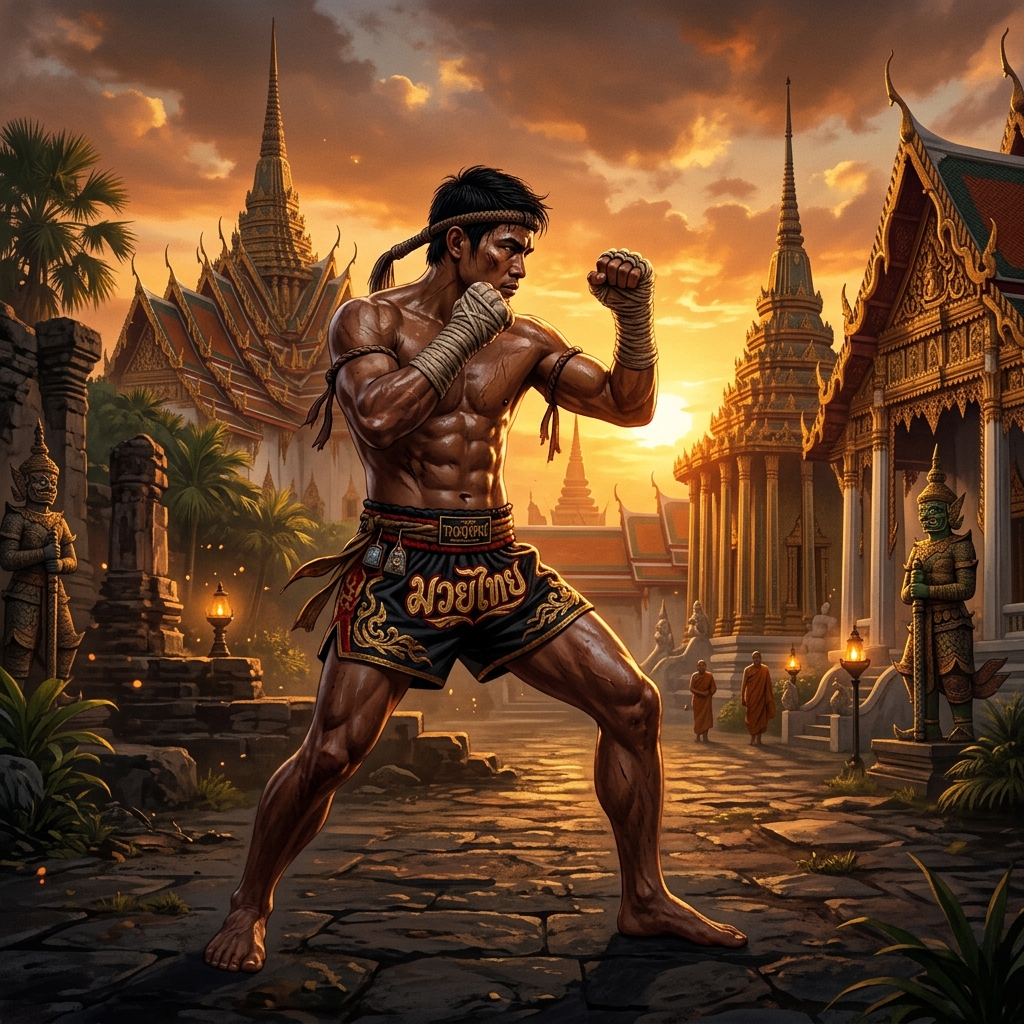
Humans have developed unarmed combat methods to ensure self-preservation, utilizing their own limbs as weapons. This structured discipline became known as **"Muay"**. Our ancestors exhibited great wisdom in inventing, adapting, and refining the usage of every body part—hands, feet, knees, elbows, and head—to strike and defend, effectively shielding vulnerable areas of the body.
Muay Thai is a highly practical art of self-defense, applicable in both real combat and sports. This discipline has been passed down and preserved by Thai ancestors across generations. In ancient times, able-bodied young men were rigorously trained in this art. When using ancient weapons like krabi-krabong (swords and staffs), lances, or spears, Thai warriors integrated highly sophisticated tactical maneuvers. Originally, these martial arts were taught exclusively within the high nobility, including royalty and military commanders, before later spreading to the common people.
"Monks who served as teachers forged an inseparable bond between Muay Thai and Buddhism. This connection is visible before every bout: fighters perform the Wai Kru ritual, recite incantations, and wear sacred protective amulets like Prajiad armbands and Mongkhon headbands."
King Pi Lo Ko unified the Thai principalities into the Nanchao Kingdom, governed by a succession of powerful rulers. During this period, the kingdom was in constant conflict with China, alternating between periods of alliance and hostility. Warfare training involved combat on horseback, using spears and halberds. In the Lanna region, self-defense styles and 'Jeng' (a Chinese martial art style similar to Kung Fu) were practiced alongside weaponry and military treatises. Unarmed combat did exist, mostly utilized in close quarters, influenced heavily by Chinese styles.
During the Sukhothai period, unarmed combat via Muay Thai was actively utilized alongside various weapons to defend and reclaim the nation's sovereignty. The institutions providing training in Muay Thai were divided into three main pillars:
Buddhist monks with exceptional martial skills passed down combat techniques hand-in-hand with moral teachings.
Experienced veterans and masters taught Muay Thai to sons and daughters interested in the warrior's path.
Taught self-defense and mounted weaponry on horses, elephants, oxen, and buffaloes for royal service.
* The Yonok Chronicles record King Mengrai and King Ramkhamhaeng riding elephants to hunt with their retinues, demonstrating supreme mastery of mounted combat.
This era saw a continuous evolution of martial arts inherited from Sukhothai. Temples remained centers of learning for both academic subjects and weapon mastery (swords, staffs, kris, Muay Thai, and archery). Outdoor games were highly popular, peaking during the reign of King Narai the Great, marked by grand boat races and highly celebrated boxing tournaments.
The King was extraordinarily passionate about boxing. On one occasion, he traveled in disguise as a common villager to a festival in Ban Rat Ruat to compete. The tournament matchmakers arranged three top-tier local fighters from Wiset Chai Chan: **Nai Klang (Medium Punch), Nai Yai (Iron Fist), and Nai Lek (Heavy Fist)** to challenge him. The disguised King Tiger defeated all three consecutively. He also personally trained his royal sons, Prince Phet and Prince Phon, in krabi-krabong and wrestling.
In 1767 AD, following the fall of Ayutthaya, Nai Khanom Tom was captured as a prisoner of war by the Burmese. During a grand religious celebration in Burma, he was selected to match against Burmese boxers. Using his supreme Muay Thai skills, he defeated 10 Burmese fighters in a row, prompting the King of Ava to exclaim:
"The Thai people, even without weapons in hand, possess poison all over their bodies, defeating opponents with bare hands alone."
Nai Khanom Tom is celebrated as the Father of Muay Thai, making this martial art legendary. At the time, fighters competed in **"Kard Chuek"** (hemp rope binding), which was sometimes coated in ground glass, rendering matches highly lethal.
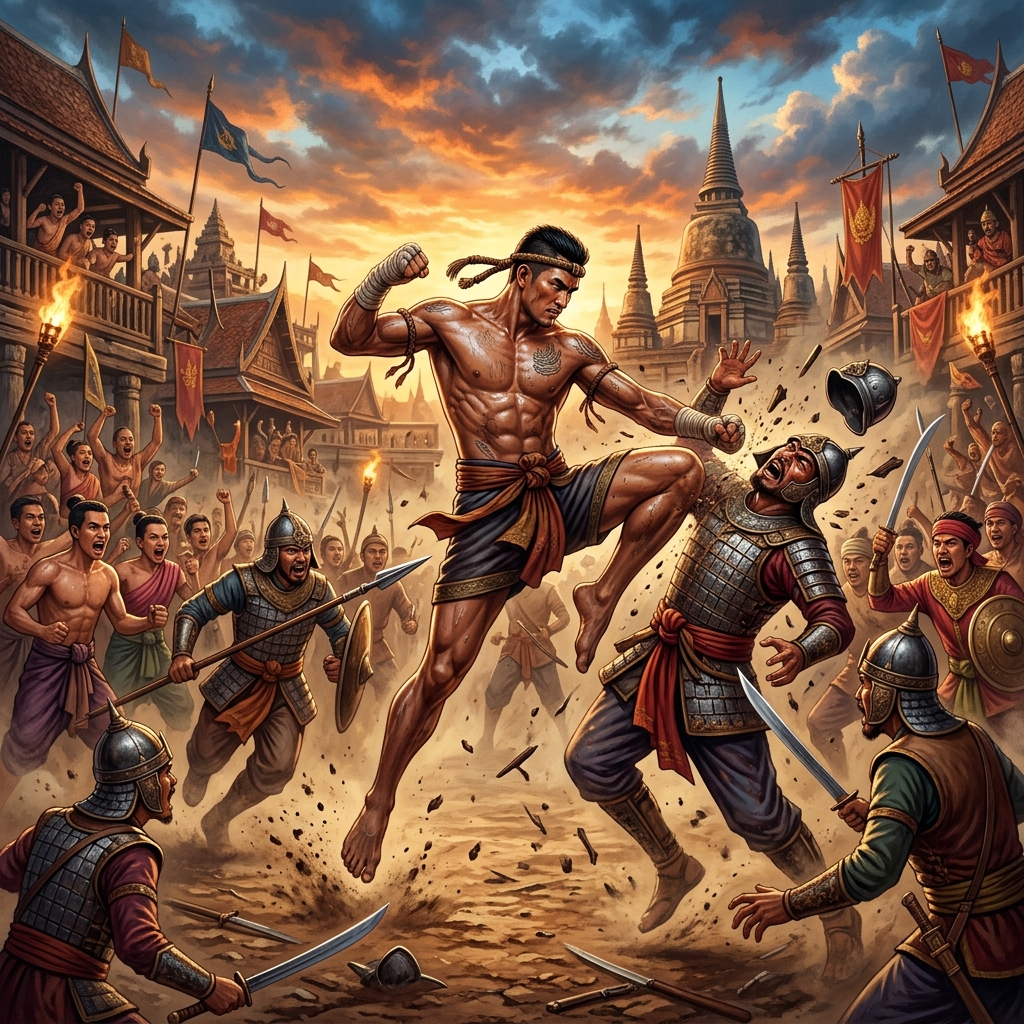
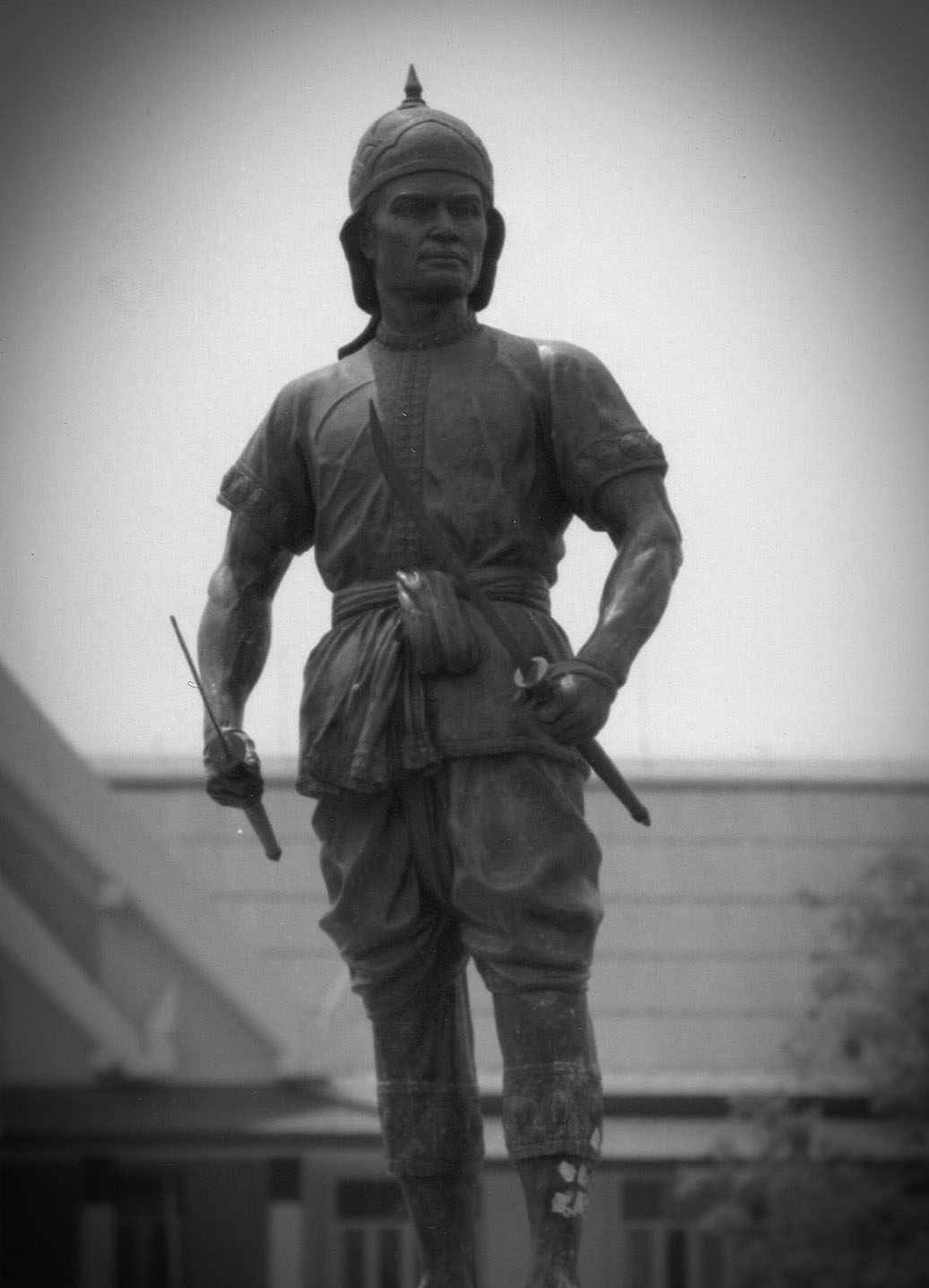
When Burmese forces invaded Chiang Mai and Phichai, Phraya Phichai led his troops into fierce close combat. Despite both of his swords breaking during the battle, he utilized his Muay Thai expertise and broken swords to successfully defend the city. King Taksin the Great subsequently appointed him governor of Phichai, and he became immortalized as **"Phraya Phichai Dabhak"** (Phraya Phichai of the Broken Sword). During this era, Muay Thai, krabi-krabong, boat racing, and takraw were widely played.
View on WikipediaA symbol of courage who utilized Muay Thai to turn the tide of battle in the face of adversity.
From Rama I to Rama V, Thai monarchs greatly favored sports. King Chulalongkorn (Rama V) bestowed titles upon outstanding fighters, such as **Muen Muay Maen Mat** (Master of Precise Punches) and **Khun Changat Ching Chok** (Lord of Decisive Strikes). Tournaments were organized across the capital and rural provinces, and official regulations were introduced under Prince Damrong Rajanubhab.
Fought in Kard Chuek style. Fixed round limits were introduced, and a referee was placed inside the ring alongside ringside judges, utilizing whistles for timing signals.
A transitional period that saw the shift from rope-binding to **padded boxing gloves** for the first time. Renowned referees of this era included Mr. Tim Atiheramanon and Mr. Niyom Thongchit.
Produced legendary fighters like Saman Dilokwilas and Sompong Wechasis. Famous referees emerged, notably Luang Phiphat Kolakay, Mr. Suntorn Thaweesith (Kru Kim Seng), and Mr. Niyom Thongchit.
The Royal Thai Army took over event organization to raise military funds, giving rise to legendary fighters such as Phon Phra Pradaeng, Phoek Singhaphalop, Thawan Wongthewet, Prasert S.S., and Thongbai Yontrakit.
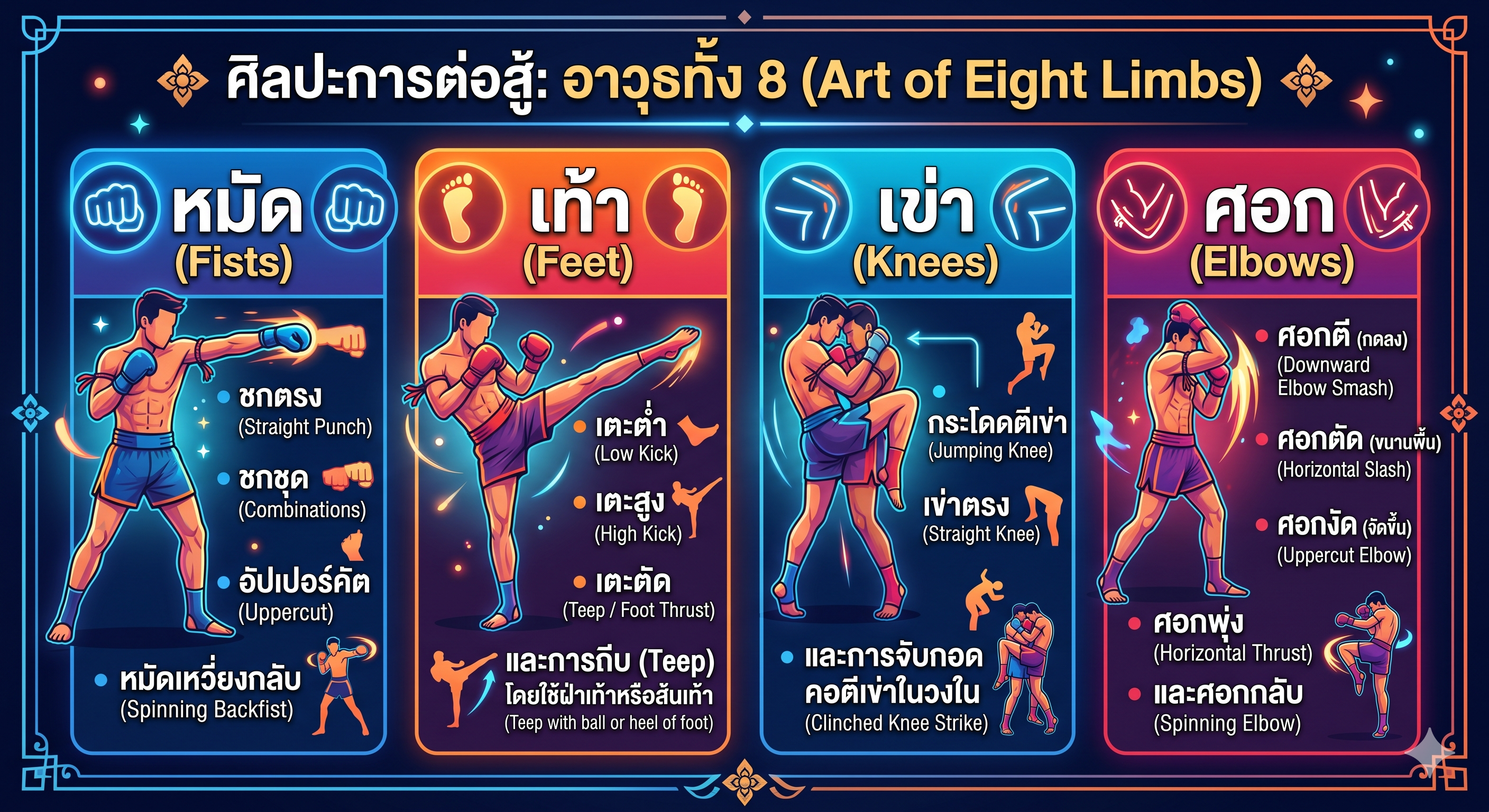
Straight punch, combinations, uppercut, and **spinning backfist**.
Low kick, high kick, roundhouse kick, and **Teep** (foot thrusts) using the sole or heel.
Flying knee, straight knee, and active knee strikes from the clinch.
Chopping elbow, horizontal elbow, uppercut elbow, forward elbow, and spinning elbow.
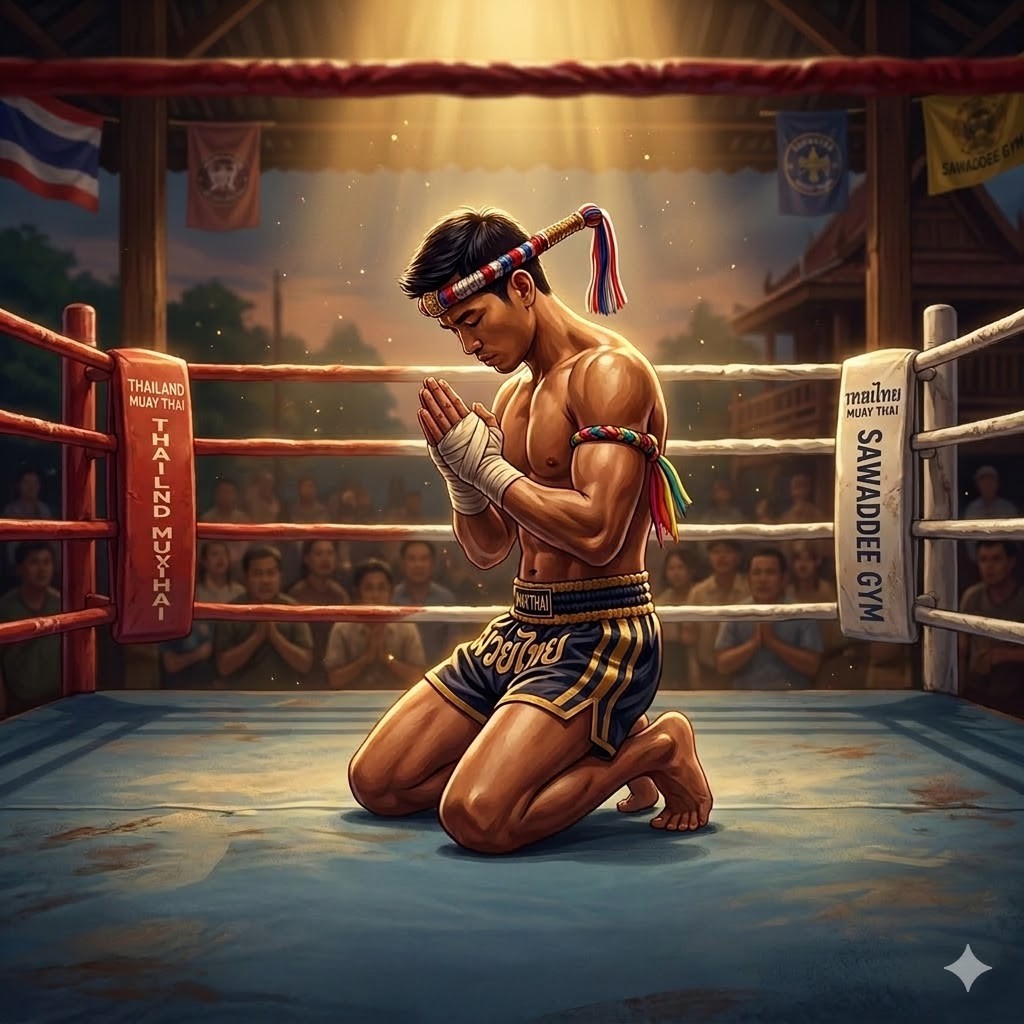
Performing three prostrations to pay respects to parents, teachers, and sacred spirits, followed by a graceful dance around the ring. Each camp has its unique ritual to summon blessings, safety, and victory.
Mongkhon: A sacred headband woven from holy thread, blessed by masters and worn during the Wai Kru ritual before the fight.
Prajiad: Sacred armbands tied around the upper arms for protection, strength, and good fortune throughout the bout.
Traditional Thai instruments including the Pi Chawa (Javanese oboe), Klong Khaek (drums), and Ching (cymbals) accompany the fight. The tempo accelerates with the action, boosting the fighters' spirits.
Today, Muay Thai is a premier professional sport and self-defense art recognized worldwide, with major tournaments across the UK, USA, Canada, Japan, and the Netherlands. Its combat effectiveness has been proven globally through countless cross-discipline challenges.